Anemoia, AI, and Skeuomorphism: The Material Turn in Digital Humanities
The following was prepared for Purdue University’s inaugural DH Day on April 7, 2026. I’ve modified the text a bit to omit some prefatory material that makes less sense in a blog post, and to change some of the “talk” language to read more clearly as a single written piece.
Introduction
At the University of Illinois, I direct Skeuomorph Press & Book Lab, “an experiential studio for teaching and researching the history and art of the book at the University of Illinois Urbana-Champaign.” My work at Skeuomorph echoes a common turn among DH scholars over the past decade, toward analog practices such as printing, zine making, baking, weaving, and other craft practices, often shared through channels such as #DHMakes.
In this post, I will work to theorize this material turn in DH through two terms, anemoia and skeuomorphism, arguing that DH scholars and students are turning toward material engagements with historical media to contextualize and critique our moment of media shift, when even computational creation is increasingly abstracted through LLMs and vibe coding. This new material turn echoes early DH’s emphasis on “hacking,” but with a key distinction. Where early DH often contrasted itself with cerebral modes of academic scholarship, today’s DH makers seek to mitigate a broader, cultural technological determinism, emphasizing human choice, design, and deliberation in the development of new media technologies.
Skeuomorphs
The term “skeuomorph” was coined—in print, at least—by Henry Colley March, a medical doctor and amateur archeologist. His work is, in the manner of much nineteenth-century social science, observational and relational, and sweeping in its purview. March published extensively on archeology and folklore, writing influential articles on subjects as varied as Roman pavement, ancient flints, “wise birds” across world folklore, and Darwinism.
In an article titled “The Meaning of Ornament,” published in the 1890 edition of the Transactions of the Lancashire and Cheshire Antiquarian Society. Colley March asserts that “the forms of ornament demonstrably due to structure require a name.” As “those taken from animals are called zoomorphs, and those from plants phyllomorphs, it will be convenient to call those derived from structure, skeuomorphs, from σκεύη, tackle, tools, vessels, equipment, dress.” The first example he offers is “thong-work,” the plaiting that originally arose to bind objects together, such as attaching an axe blade to its handle, but which then became a decorative expectation, such that “no vessel or implement could satisfy ‘taste’…without the simple device of thong-work.” In grandiose Victorian fashion, Colley March declares “As soon as man began to make things…skeuomorphs became an inseparable part of his existence, grew, as it were, with the growth of his brain.”1
The precise lineages he traces have been complicated by subsequent archeological research, but March coins “skeuomorph” to mean an ornament that mimics an earlier structure, implement, or tool, an aesthetic invocation of technology rather than the natural world. Over the next century, archeologists and anthropologists adopted the word without much change in sense. In the article I am writing on this topic, I review such uses between 1903 and 1985 to show that they largely agree with Colley March’s formulation, using skeuomorph to categorize an ornamental or decorative evocation of a form that was, to the maker, historical.
Some archeologists challenged this use of “skeuomorph.” In a 1972 article critiquing field practices in classifying megalithic tombs, Andrew Fleming argued that “the whole concept of the skeuomorph is due for a re-examination” because it “has too often been used to conceal scepticism [sic] about the capacity of prehistoric man to develop his own designs.” While conceding that “there must be cases where true skeuomorphs occur” as “innovation cannot take place in a technological vacuum,” Fleming insists that “[t]he skeuomorphic approach” underestimates the capacities of people in the past, insisting that “[d]esigners, priests, and craftsmen are not half-witted copiers.”2 To Fleming, archeologists had become too quick to assign skeuomorphic interpretations to artifacts, in ways that distorted the accomplishments of their subjects and imposed a historical determinism on their accounts.
However, both the uses and critiques of skeuomorphs in this literature bifurcate functionality and aesthetics in ways that obscure both. The mere existence of skeuomorphs testifies that function can be—or can become, through cultural adoption and familiarity—aesthetically valued. Conversely, aesthetics can be functional, as design elements guide use. Long histories of visual art, music, theater, writing, and other arts and crafts teach that incorporating and experimenting with historical forms and influence can be far more than mindless copying.
In the 1990s and early 2000s, amid a widespread cultural shift toward computation, the discussion of skeuomorphism expanded to include scholars in media studies, book history, and even computer science; as well as professionals in fields such as user interface and experience design, or UI/UX; and also scholars in the fields that would become digital humanities. In 1998, Nicholas Gessler—of UCLA’s Anthropology, Computational Evolution, and Ecology Group—described skeuomorphs as “cultural algorithms” and “material metaphors”
They are informational attributes of artifacts which help us find a path through unfamiliar territory. They help us map the new onto an existing cognitive structure, and in so doing, give us a starting point from which we may evolve additional alternative solutions.
Here Gessler is not writing about ancient humans, but instead about the use of skeuomorphs in the culture—and in particular, in the design of computational systems—in the late 1990s. Gessler notes the skeuomorphism of language itself, as “the proliferation of the Turing machine” meant “such devices came to be called computers in metaphoric reference to their human progenitors” until only the machines were left: “The computer became the object itself and those who did the computations became programmers.” In this account, skeuomorphs are not simple imitations, but complex assemblages of form, function, and cultural referent, such that “Once thought is given material substance, it is not always clear what is a skeuomorph and what is not.”3
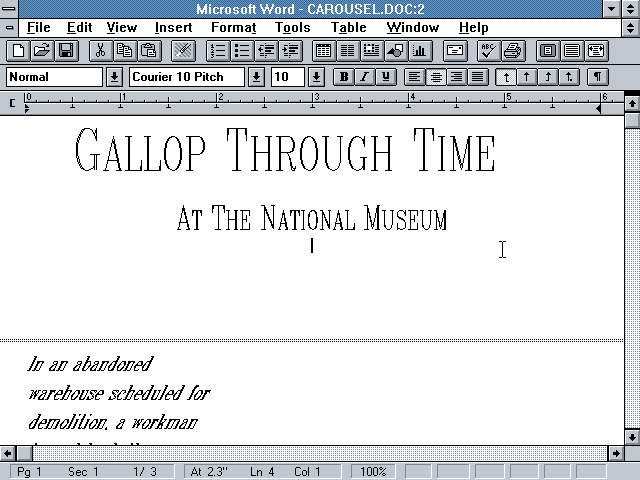
For example, the floppy disk save icon likely appeared in the early 1990s. Pinning down its precise origins proves frustratingly difficult, but we know it was used in Microsoft Word 2, which was released in 1991. At that time, the floppy disk was not purely a skeuomorphic representation of saving—the 3.5” floppy that most commonly appears in save icons was still a primary means of saving files. But in 1991 the floppy was only one storage possibility, as users could also click that icon to save to their hard drive or—more common in businesses—networked storage. In just the next few years, high-capacity zip drives and then consumer-grade writeable CD drives would come into the market. The floppy disk save icon, in other words, emerged precisely at the moment of its transition from direct referent to skeuomorph.
In a culture in the midst of a profound socio-technical shift, the skeuomorph marks an inflection point, a shifting boundary marker along what Alan Liu describes as the “thick, unpredictable zone of contact” between new media and old, “more borderland than border line.”4
As N. Katherine Hayles wrote in an article on cybernetics in 1994, “Like a Janus figure, the skeuomorph can look to both past and future, simultaneously reinforcing and undermining both.” Rather than seeing the skeuomorph as merely retrospective, Hayles positions them as “threshold devices, smoothing the transition between one conceptual constellation and another.”5 The skeuomorph is both pedagogical—teaching how to use a new medium by reference to an older, familiar medium—and ideological—suggesting the best use of a new medium.
DHMakes
The floppy disk icon brings us back to Skeuomorph Press, which we named after one of my students, Isabella Viega, commented on how often I use skeuomorphs in my classes to discuss historical media shifts. They said “you should just call the press ’skeuomorph!’” and so we did.

The press’ mark, or logo, was adapted from the floppy disk icon as a way to mark the kinds of cross-historical conversations we hope to foster in our space. At Skeuomorph, we sponsor applied research in book history and creative projects by students and faculty, offer experiential workshops in the history of print technologies, teach modules in classes across departments, and foster a community of makers on campus. Skeuomorph houses an ambitious collection of metal and wood type, as well as printing presses, typewriters, and vintage computers.
When we bought a collection of type from a retiring printer in Iowa this year, he described Skeuomorph as “a working museum,” and I’ve grown to embrace this label. We work to collect functional historical technology that students and patrons can tinker with in hands-on ways through our classes, workshops, public events, and evening community hours. We note on our website that “we are especially interested in experiments that blend historical and contemporary technologies.”
While we certainly offer instruction in historical media and methods, our ultimate goal in teaching historical technologies is not to cosplay or simulate the past—a frankly impossible goal—but to model particular features of historical media and methods that can help us reflect on the present.
Skeuomorph is one of a growing network of “book labs” and similar humanities maker initiatives around the country, from the University of Maryland’s BookLab—founded by Matthew Kirschenbaum and Kari Kraus—to Stanford’s Textiles Makerspace—founded by former ADHO president Quinn Daedal, to Amanda Visconti’s—head of UVA’s Scholars Lab—recent experiments with letterpress.
Since 2023, Rare Book School has offered a regular course about establishing book labs, and when Skeuomorph put out a call for a ”Building Book Labs” symposium last year, we were forced to expand what we thought would be a small, intimate gathering to accommodate a flood of applicants. That event brought together scholars from longstanding initiatives, newer programs like Skeuomorph, and those exploring founding such an initiative on their campus, and will be followed up by a symposium at the University of Toronto in summer 2026, and other institutions after that. As one informal index of this movement’s growth, at the symposium we started a BookLabs mailing list that now boasts more than 120 members, actively sharing events, resources, and ideas. Not all of the leaders in the current book lab movement come from the digital humanities, but DH scholars make up a notable segment of the Venn diagram, along with colleagues from traditional humanities disciplines, library and information science, and adjacent fields.
Across those disciplines, scholars are finding new value in analog and craft practices, sharing a sense that they are especially valuable in our current socio-technical moment. Even as we train students in methods such as vector space analysis or large language models, scholars are increasingly asking students to set type, sew book bindings, pull cotton rag paper, or knit a data physicalization. The materiality of these experiments illuminates in two directions: making the technologies, materials, and laborers of historical communities more visible, but inevitably pointing—by comparison or contrast—to the complex web of socio-technical systems that underly our own historical moment.
In 2024 Isabella Viega and I interviewed scholars working in “humanities maker labs” around the country to understand why so many scholars are turning toward material investigation, experimentation, and critical making in their research and teaching. In extreme brief, our interviewees frequently echoed Matthew Kirschenbaum’s ideas, quoted in our whitepaper, noting the value of “tangible…work with the hands” for thinking, noting that such tactile experience often translates to better work with programming and digital tools.6
When arguing for the value of a space like Skeuomorph for students in information science, who may or may not have an explicit interest in the history of our collection, I often note that the deliberation required, and even the constraints imposed, by a technology like letterpress translates to design thinking valuable in coding, UI/UX design, and related information science skills. In her interview for our whitepaper, Kirstyn Leuner, head of Santa Clara University’s Digital Humanities Initiative Letterpress studio, argued that the limitations of material engagement prove valuable for students’ thinking as “they’ll come up with something because they have to, because you’re limited to the typefaces that we have, the sizes that we have, what other people aren’t using.” In the digital age, where excess of choice is the norm, Leuner framed these restrictions as pedagogical affordances, recognizing, “they’re used to not being limited in terms of writing and thinking about composition.” Several participants pointed to these kinds of boundaries as conducive to critical thinking and creativity, as students have to work with not only the materials available, but the particular and media-specific constraints of the technologies that use those materials.
We can trace a similar emphasis on the value of the tactile and the material in the constellation of activities collected under the moniker #DHMakes, where digital humanities and adjacent scholars use social media to share their work knitting, zine making, paper piercing, and more. Initially born out of a desire to connect during the most socially-isolated moments of the COVID-19 pandemic, #DHMakes has since grown into an active online community, even sponsoring workshops and panels at DH conferences—including one planned for the upcoming Digital Humanities Conference in Korea this coming summer—and supporting an ongoing series of online methods talks.
In an article outlining the history and guiding ethos of #DHMakes, Amanda Visconti, Quinn Daedal, and Claudia Berger argue that the movement’s making emphasizes the tactility of digital infrastructure obscured by metaphors such as “the cloud,” while highlighting the history of computing in practices such as textile production, which can be obscured by gendered narratives of the field.
They write, “Representing digital work physically connects us back to the materiality of our digital making and serves as a reminder that the physical is not as distant as we might imagine.” Here again the tactile serves as an alternative means of knowing—thinking through the hands, iterating, tinkering. Visconti, Daedal, and Berger argue “infusing” these craft practices, their values, and the histories they embody will prove essential for “the next generation of digital humanities.”7 I would suggests that the narratives surrounding book labs and #DHmakes alike center on ideas of media and technological transition, of paradigm shift—certainly within fields such as digital humanities, but also across the larger culture, that demand special attention and deliberation.
Hack-Yack
Visconti, Daedal, and Berger contextualize their discussion of #DHMakes by tracing a longer history of conversations about making in the digital humanities. In the early 2010s, DH practitioners alternatively embraced and contested a dictum, “more hack; less yack” that “began,” as Bethany Nowviskie describes, “as a goofball joke” at a 2008 THATCamp conference. Originally intended as a funny mantra for a conference that sought to focus less on long papers and more on collaborative work and method sharing, “hack vs. yack” became a shorthand for debates over digital humanities, with scholars whose work was largely grounded in “expert verbal exchange,” as Nowviskie explains, “surprised and insulted” to see language “apparently denigrated,” while “staff asked to produce or maintain technical systems” might see “too much yack and not enough hack in the working day” as a guarantee they would need to “come in early and stay late” to get the work done. 8 Despite outrage cycles on Twitter—remember academic Twitter?—Nowviskie identifies the crux of the “more hack; less yack” less in epistemology, and more in the practical challenges of bringing together in a single scholarly community humanities scholars, librarians, and technicians whose working lives are evaluated by quite different metrics.
Indeed, another of the most infamous quotes in the history of the digital humanities also started as a bit of a joke. At the 2011 MLA Convention, Stephen Ramsay contributed to the “History and Future of Digital Humanities” panel, in which panelists were asked to offer a three-minute provocation, to be followed by discussion and debate. Ramsay began by noting that “with only three minutes…you can’t do much of anything except piss off half the people in the room,” and a single line from his talk not only pissed off people in the room but became perhaps the bogeyman of the great DH debates:
Do you have to know how to code? I’m a tenured professor of digital humanities and I say “yes”.
This line quickly became a meme, cited in nearly every piece about the digital humanities over many years. It was most typically cited as evidence of the field’s exclusivity, or its complicity in the STEM takeover of education.
However, if we read just the next few lines of Ramsay’s provocation—and these are rarely cited—it becomes clear he was trying to articulate how DH practice differed by program and institution—what they called “DH” at Nebraska would include coding, but what they called “DH” at Dartmouth might not.
Do you have to know how to code? I’m a tenured professor of digital humanities and I say “yes.” So if you come to my program, you’re going to have to learn to do that eventually. Does it have to be about text? If you go to, say, the University of Alberta, I suspect the answer might be “no” – a reflection, again, of the faculty, many of whom have been in the field for a long time. But what if Duke or Yale were to offer a degree in Digital Humanities and they said “no” to code and “yes” to text? Or “no” to building and “yes” to theorizing? Or decided that Digital Humanities is what we used to call New Media Studies (which is the precise condition, as far as I can tell, at Dartmouth)? You might need to know how to code in order to be competitive for relevant grants with the ODH, NSF, or Mellon. Maybe that means Yale’s DH ambitions will never get off the ground. Or maybe Yale is powerful enough to redefine the mission of those institutions with respect to the humanities. Most institutions, for the record, are not.
Even as a provocation, this much-maligned text is more about the difficult of defining DH than it is about setting an exclusive definition, though that nuance is less likely to generate clicks.9
In this post, however, I’m more interested in Ramsay’s followup piece, “On Building”—originally published on Ramsay’s blog and now available in the 2013 collection Defining Digital Humanites — which makes a stronger argument for a digital humanities grounded in making:
As humanists, we are inclined to read maps (to pick one example) as texts, as instruments of cultural desire, as visualizations of imperial ideology, as records of the emergence of national identity, and so forth. This is all very good […] But making a map (with a GIS system, say) is an entirely different experience. DH-ers insist—again and again—that this process of creation yields insights that are difficult to acquire otherwise…People who mark up texts say it, as do those who build software, hack social networks, create visualizations, and pursue the dozens of other forms of haptic engagement that bring DH-ers to the same table. Building is, for us, a new kind of hermeneutic.10
Under this more capacious framework, Ramsay argues that one codes to inculcate richer engagement with software, not as a consumer, but as a practitioner who understands the infrastructure and labor—both intellectual and technical—that enable software to function.

In many ways this perspective recalls to me Robert Darnton’s famous diagram of the “communications circuit”—which I maintain is the most widely reprinted diagram in humanities scholarship—which urged scholars in history, literary studies, and related fields to “envisag[e] the entire communication process” through which “books come into being and spread through society.”11 This depiction of book production has been much debated, amended, and rebutted—including by Darnton himself—but the key insight which arguably launched the field of book history was that understanding books requires an infrastructural perspective that includes not only authors and editors but the laborers whose craft and technical expertise carried texts to readers. Book history argues that interpreting only the words inside books obfuscates or erases many of their political, economic, environmental, and cultural meanings.
Similarly, much of early digital humanities’ focus on hacking, building, and making sought to inculcate an infrastructural perspective on computation: one that was active and conscious rather than passive and consumptive. In the subsequent decade plus, these mandates have expanded in salutary ways.
For example, the #DHMakes authors take a prompt from Natalia Cecire’s “Theory and Virtues of Digital Humanities,” in which Cecire notes that the “specific vision” offered by many digital humanities metaphors—such as “digging,” “mining,” and “building”—is “distinctly social” and “virtuous,” but also “distinctly white, male” and “blue-collar.” Cecire asks how “the field might look very different if the dominant metaphors for ‘doing’ digital humanities included weaving, cooking, knitting, and raising or nuturing.”[^Cecire] In 2026, such metaphors abound, not only among #DHMakes practitioners but also in scholarship from digital humanists such as Lauren Klein, who directs our attention not simply to the codework, but also the carework essential to tool development and maintenance.12 These are only a few examples to show how both the activities gathered under the category “making” and the DH metaphors we draw from those activities are widening to include a much broader swathe of creative and craft practices.
Anemoia
In the final section of this talk, I will turn back to skeuomorphism and introduce a new term, anemoia, to theorize the digital humanities’ material turn, particularly in light of the growth of artificial intelligence in our cultural and institutional systems. I will argue that activities such as letterpress printing or knitting can represent a deliberate, methodological skeuomorphism that casts the technological present in critical relief. These analog pursuits are neither reactionary nor regressive, but instead manifest an embodied criticism particularly suited to our current moment of media shift. As even programming becomes a more distant activity, often filtered through a chat interface rather than lines of code, scholars turn toward historical praxis to both contextualize our technological present and cultivate alternative visions of the future.
In their introduction to the dh+lib issue on critical making, the editors report they are “taking inspiration from cooking blogs” in the structure of their issue, and argue that data physicalization is valuable for DH practitioners because it locates computation within history and demystifies its operations:
If we take an expansive definition of digital humanities, where digital humanities is the process of using technologies to help us pursue and answer humanities questions, then digital humanities doesn’t have to be digital. Indeed, not all technologies are digital, and exploring non-digital technology can help us reconnect to another meaning of digital, referring to fingers and hands, which underscores the broader issue of how we can think about computation as something extra- or non-human rather than being a fundamental part of the human experience. Woodwork, ceramics, and weaving are all technologies that predate computers. In fact, advanced weaving looms helped inspire the first computers. Weaving, knitting, lacemaking are all algorithmic and such fabric-based making is a way of demystifying how computers function—they aren’t these weird magic boxes, but are related to these everyday activities that have been going on, in some cases, for millennia.
These arguments echo those made by Ursula K. Le Guin, one of the twentieth-century’s great science fiction authors, in her short piece, ”A Rant About ‘Technology.’” In that article, Le Guin takes aim at a reviewer who dismissed her fiction as not “real” science fiction because “technology is carefully avoided” in her work. Le Guin counters by arguing, essentially, that her reviewer has a narrow and uninteresting definition of technology. She defines technology as “The active human interface with the material world,” a definition that includes computers and space ships, but also “flax…paper, ink, wheels, knives, clocks, chairs, aspirin pills,” and “steel saucepans with copper bottoms and fleece vests spun from recycled glass.”
Le Guin suggests that, when considering any technology, whether historical or contemporary, one might ask “Do I know how to make one?” Ultimately, Le Guin sees technologies pedagogically:
I don’t know how to build and power a refrigerator, or program a computer, but I don’t know how to make a fishhook or a pair of shoes, either. I could learn. We all can learn. That’s the neat thing about technologies. They’re what we can learn to do.
Refusing a reductive, presentist view of technology, Le Guin instead offers a cross-historical continuum in which technologies from flax to silicon chips converse, and register different facets of humans’ “active interface with the material world.”
This past year, we sought and were granted permission from Ursula K. Le Guin’s estate to produce an edition of “A Rant About ‘Technology.’” The books were illustrated by iSchool MSLIS student Delia Kerr-Dennhardt, handset in type by me, then printed and bound by Skeuomorph staff and students. One goal for this work was certainly to produce a beautiful edition of a text important to the press’ thinking and mission; another was to raise money for the press. But planning and executing this edition also fostered key digital humanities skills: e.g. collaboration, project management, design, outreach. Students had to learn new technical abilities and consider how decisions about format, structure, and materials would reverberate across the stages of the project. I am not claiming this work was secretly digital humanities the whole time, but something more subtle and, I would argue, more important: that the negotiations letterpress requires between expressive possibility and technical feasibility echoes the negotiations of DH work. The two activities are mutually reinforcing.
In their discussions of hacking, building, and making, we see that DH scholars do not generally seek to convey simple technological skills, but instead to cultivate technological imagination. Specific platforms, applications, and even coding languages come and go, but a technological imagination is able to abstract a problem—whether intellectual, professional, or personal—and formulate a plan for how a tool or suite of tools might help answer it. Learning to systematically approach a weaving project—and then iterate, experiment, and improve as you undertake it—inculcates habits of mind—a praxis—that proves useful when tackling a coding problem. The complexity of current technological systems, most dramatically evident in the black boxes of artificial intelligence platforms, exacerbates a sense of alienation that hacking, building, making, and indeed crafting seek to ameliorate.
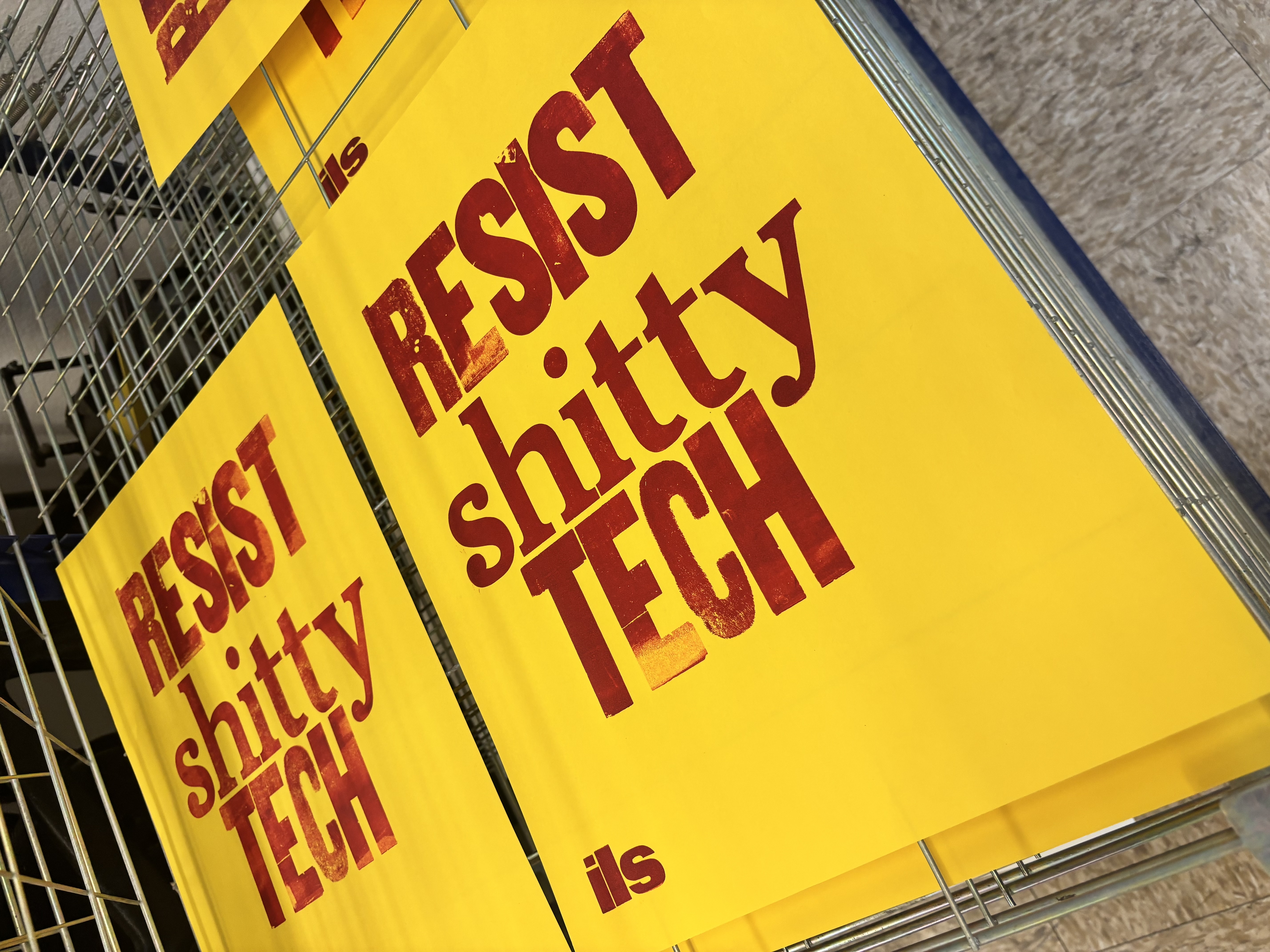
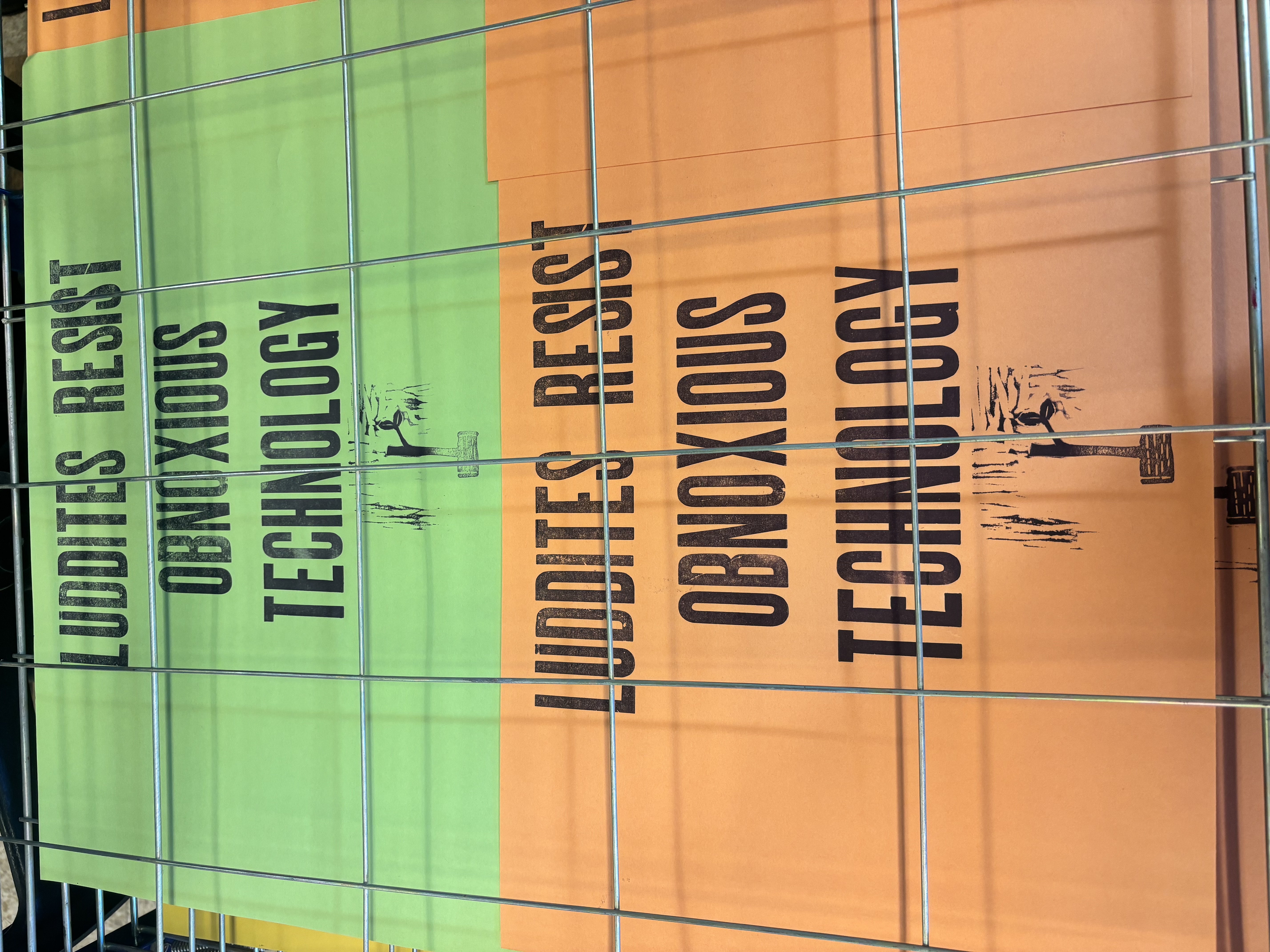
I do not think it is accidental that Skeuomorph’s researchers, students, and patrons increasingly situate their work with our “dead media” as responses—whether humorous, serious, or sanctimonious—to the emergence of computational—and especially AI—systems in their educational and professional lives. This past year we were a primary host for the Illinois Luddite Society, founded by students in philosophy, who used our community open hours to design and print posters encouraging our campus community to “resist shitty tech” or “resist obnoxious technology.” I do not think it is a contradiction to declare, as a professor of information science and digital humanities scholar, that I am thrilled to see students taking Luddism seriously. The term “Luddite” was so thoroughly co-opted by the industrialists who violently suppressed this labor movement that we now use it as a synonym for “technophobe,” but the movement itself sought to protect worker’s rights in an age before unions.
As Cory Doctorow writes, “Smashing looms and stocking frames was the Luddites’ tactic, not their goal,” which was “to challenge not the technology itself, but rather the social relations that governed its use.” Doctorow insists “We’re living in quite a Luddite moment” because “Many of us are contesting the social relations surrounding our technologies.” Doctorow argues that “automation isn’t solely disempowering: it also lifts people up” but only when “the bounty of automation” isn’t “disproportionately allocated to a small number of capital owners.” In its most generative (pun intended?) form, digital humanities offers students and practitioners what Doctorow calls “technological self-determination.”13
Prints such as those by the Illinois Luddite Society—or Amanda Visconti’s recent print invocations of the Luddites—use historical media and materials to challenge dominant technological narratives in the present.
These invocations of the past lead us necessarily to the idea of nostalgia. There is an affective response to historical media, which we frequently witness at Skeuomorph, that must be part of this discussion. When students—or just as commonly, faculty and patrons—lionize a machine like the printing press as more “real,” “authentic,” or “artistic” than the computer, they risk flattening a complex historical artifact into an idealized and misleading symbol. The printing press has many virtues, but we should not erase the fact that is was a machine designed for industrial production, or the ways it contributed to systems of oppression as much as liberation. As Tobias Becker writes, historians have long held a “deep-seated disciplinary aversion against nostalgia” because “While history explores the past to better understand it […] nostalgia falsifies it to feel better in the present; and, to that end, forgets, disregards or ignores the horrors of the past.”14 In 2026, there are insidious versions of nostalgia at play in our politics that exemplify this concern.
However, Becker also argues that the strongest stance against nostalgia emerged from a particular historical moment, when “intensifying doubts about progress…increased as the costs of progress and the failures of post‐war hopes became harder to ignore.” Becker argues that nostalgia is seen as “irrational and pathological” within a paradigm that sees history as progress:
The idea of progress, the belief that the things will be getting better as time progresses, that the past needs to be overcome, destroyed even, on the way to the future, is the ultimate expression of the modern understanding of time, according to which time is dynamic, linear, homogenous and universal. (44)
This is the framework that Doctorow and others see under enormous pressure in the present, and to which the material turn in DH might be understood as a corrective.
Indeed, “nostalgia” is perhaps not the right term to describe the technological ethos of this work. The movable type, printing presses, typewriters, and vintage computers in our collection were all practically obsolete long before my students were born. Indeed, while there were certainly people printing with letterpress when I was younger, as there are now, it was never the dominant medium of production in my lifetime. John Koenig’s Dictionary of Obscure Sorrows is “a compendium of new words for emotions” that began as a website and YouTube channel around 2015, and was eventually compiled into a printed dictionary, published in 2021. In Koenig’s dictionary, “dès vu” is “the awareness that this moment will become a memory,” while “sonder” is defined as “the realization that each random passerby is the main character of their own story, in which you are just an extra in the background.” The Dictionary is still growing at https://www.thedictionaryofobscuresorrows.com, but I want to focus on the entry for “anemoia,” which is defined as “nostalgia for a time you never experienced.”
In the book, Koenig uses the “anemoia” entry to reflect on the absolute distance between us and the people we see in a historical photograph: “If the past is a foreign country, we’re only tourists.” He also makes what I find a quite moving point about the historical lives we study from this distance:
Of course, to them, it wasn’t all flickering silence and grainy black-and-white. They saw vivid color rushing by in three dimensions, heard voices in deafening stereo, confronted smells they couldn’t escape. For them, nothing was ever simple. None of them knew for sure what this era meant, or that it was even an era to begin with. At the time, their world was real. Nothing was finished, and nothing was guaranteed.
The people who made their livings operating printing presses or working a treadle loom were not benighted simpletons twiddling their thumbs, waiting anxiously for the invention of the microprocessor. They were complex human beings interfacing with the material world using the most complex tools at their disposal. They were developing ideas about communication, technology, media, and aesthetics that carry forward into our own time, through what Alan Liu describes as “the déjá vu haunting of new by old media.”
The key distinction between nostalgia and anemoia is distance. In a modern book lab, we simply cannot simulate the full lived reality of a historical print shop. We bring to an encounter with an iron hand press the mediations of institutional and professional situation, and loss, of both material and knowledge. We also necessarily bring our contemporary technological situation. We notice that the ink pattern made by large wooden type is both aesthetically satisfying and easier on our eyes than a glowing screen; we also notice that metal type is frustratingly fiddly. When we work with historical technologies, our distance from them helps us notice their affordances and limitations more clearly than we can the technologies of our own era. The distance of anemoia, I want to suggest, can be a heuristic for perceiving the technical, social, and political operations of media technology that can be opaque in any present. Historical making asks us to slow down, to be deliberate about our technological choices, to practice habits of mind and body that prove useful when returning to contemporary technologies.
Conclusion
In a 2013 talk at the Modern Language Association Convention, Bethany Nowviskie reflected on William Morris’ famous axiom, “You can’t have art without resistance in the materials.” Nowviskie notes that Morris supposedly uttered these words in “extended complaint about a newfangled device: the typewriter.” Nowviskie observes that Morris simultaneously celebrates one kind of resistance—”The very slowness with which the pen or the brush moves over the paper, or the graver goes through the wood”—while decrying another—”the machine sticking or what not.” Nowviskie calls the latter “the plaint of a passive tool-user” and argues “The resistance in the typewriter Morris imagines, and the resistance DH novices feel when they pick up fresh toolsets or enter new environments, is different from…that happy resistance still felt by hands-on creators of humanities software and encoding systems.”
Nowviskie ties this distinction to changes she sees happening in the digital humanities, in a moment of enormous growth for the field:
Until quite recently, every self-professed digital humanist I knew was deeply engaged in tool-building, and in the most fundamental and direct kinds of humanities re-mediation […] No matter the type, our tools had one thing in common: overwhelmingly, their own users had made ’em, and understood the continual and collective re-making of them, in response to various resistances encountered and discovered, as a natural part of the process of their use. In fact, this constructivist and responsive maker’s circle was so easily and unavoidably experienced as the new, collaborative hermeneutic of humanities computing, as the work itself that—within or beyond our small community—we too rarely bothered to say so.
Nowviskie then demonstrates how these conditions were changing for the field in 2013, and I would argue we are witnessing another, similar shift today. However one felt about calls for humanists to code a decade ago, in 2026 AI platforms promise no one will need to code anymore. In fact, it is the two poles of the old digital humanities debates—hacking and yacking—that are together under the most significant pressure due to technologies such as large language models. Just as writing instructors worry students will offload their work to LLMs, and thereby skip essential steps of thinking and deliberation, computer and information scientists are grappling with the implications of programs and software written without a grounded understanding of technical systems.
The chat interfaces of LLMs appear to offer very little “resistance in the materials,” which could open up previously exclusionary practices to more people, but which could jeopardize the foundations of our information infrastructure. I would suggest that anyone who claims to know precisely where we are headed is selling something. Just like the historical people that Koenig writes about, we do not know for sure what our era will have meant. For us, as for them, nothing is finished, and nothing is guaranteed.

It seems notable to me that (at least) two major agentic AI platforms lean heavily into skeuomorphism in their marketing: Meta recently acquired Manus, which brands itself as “hands-on AI” and whose logo resembles nothing so much as a manicule, linking their textual interface to a media tradition that spans the ancient world through the medieval and print eras. The name of OpenAI’s coding platform, Codex, similarly references our bookish past. Rather than emphasizing the newness of LLMs, these skeuomorphs work to identify these technologies with a longer timeline, to suggest familiarity and reliability. (if there’s time in the Q&A, I’d love to discuss the skeuomorphic qualities of LLMs’ chat interfaces)
We can be skeptical of Meta and OpenAI’s intentions here. But their skeuomorphic invocation of book history aligns, even accidentally, with the argument I’ve been building in this talk. For decades UI/UX designers have debated whether skeuomorphic design is good, because it helps users understand new platforms and media, or whether it weights new technology down with historical referents and expectations. Digital humanists can also refuse this dichotomy. The notion of a skeuomorph as “looking backward” assumes a directionality of media change. If new media is by default better, faster, more efficient, more effective, then remnants of earlier media can “hold back” its potential—keep it mired in the past rather than pressing toward the future. If instead old media speaks to cultural values, aesthetic preferences, or expressive possibilities, then the skeuomorph is something different: an assertion of history and all its complexities as shot through the present.
A skeuomorph embeds a theory about the active interface between humans and the material world: it suggests which aspects of media are vital to retain, and which might be learned from and discarded. Skeuomorphic praxis mitigates against technological determinism, showing the choices made in the design and operation of a new medium or technology. We exist in the borderland between new media and old. Even as we experiment with large language models, practices such as letterpress printing and knitting harmonize with the digital humanities’ longstanding commitments to sustained and deliberate engagement with technology, and bring a welcome, salutary resistance back into the materials of our daily work.
-
Colley March, H. “The Meaning of Ornament.” In Transactions of the Lancashire and Cheshire Antiquarian Society. Lancashire and Cheshire Antiquarian Society, 1890. https://archive.org/details/transactionslan06socigoog/page/n180/mode/2up. ↩
-
Fleming, Andrew. “Vision and Design: Approaches to Ceremonial Monument Typology.” Man 7, no. 1 (1972): 57–73. https://doi.org/10.2307/2799856. ↩
-
Gessler, Nicholas. “Skeuomorphs and Cultural Algorithms.” In Evolutionary Programming VII, edited by G. Goos, J. Hartmanis, and J. Van Leeuwen, vol. 1447, edited by V. W. Porto, N. Saravanan, D. Waagen, and A. E. Eiben. Lecture Notes in Computer Science. Springer Berlin Heidelberg, 1998. https://doi.org/10.1007/BFb0040776. ↩
-
Liu, Alan. “Imagining the New Media Encounter.” In Companion to Digital Literary Studies. Blackwell Companions to Literature and Culture. Blackwell, 2008. http://www.digitalhumanities.org/companion/view?docId=blackwell/9781405148641/9781405148641.xml&doc.view=print&chunk.id=ss1-3-1&toc.depth=1&toc.id=0. ↩
-
Hayles, N. Katherine. “Boundary Disputes: Homeostasis, Reflexivity, and the Foundations of Cybernetics.” Configurations 2, no. 3 (1994): 441–67. ↩
-
Cordell, Ryan, Kyungwon Koh, and Isabella Viega. Surveying the Humanities MakerLab Movement. 2024. https://doi.org/10.17613/ad2j-cc02. ↩
-
Visconti, Amanda, Quinn Dombrowski, and Claudia Berger. “#DHmakes: Baking Craft into DH Discourse.” Korean Journal of Digital Humanities 1, no. 1 (2024): 73–108. https://doi.org/10.23287/KJDH.2024.1.1.5. ↩
-
Nowviskie, Bethany. “On the Origin of ‘Hack’ and ‘Yack.’” In Debates in the Digital Humanities 2016. Debates in the Digital Humanities. University of Minnesota Press, 2016. https://dhdebates.gc.cuny.edu/read/untitled/section/a5a2c3f4-65ca-4257-a8bb-6618d635c49f. ↩
-
Ramsay, Stephen. “Who’s In and Who’s Out.” In Defining Digital Humanities: A Reader, edited by Melissa Terras, Julianne Nyhan, and Edward Vanhoutte. Routledge, 2013. https://www-taylorfrancis-com.proxy2.library.illinois.edu/reader/download/91b1ac73-f42e-429a-acca-2c6ce3afd248/chapter/pdf?context=ubx. ↩
-
Ramsay, Stephen. “On Building.” In Defining Digital Humanities: A Reader, edited by Melissa Terras, Julianne Nyhan, and Edward Vanhoutte. Routledge, 2013. https://www-taylorfrancis-com.proxy2.library.illinois.edu/reader/download/91b1ac73-f42e-429a-acca-2c6ce3afd248/chapter/pdf?context=ubx. ↩
-
Darnton, Robert. “What Is the History of Books?” Daedalus 111, no. 3 (1982): 65–83. ↩
-
Klein, Lauren F. “The Carework and Codework of the Digital Humanities.” Lauren F. Klein, June 9, 2015. http://lklein.com/2015/06/the-carework-and-codework-of-the-digital-humanities/. ↩
-
Doctorow, Cory. “Cory Doctorow: Science Fiction Is a Luddite Literature.” Locus Online, January 3, 2022. https://locusmag.com/feature/cory-doctorow-science-fiction-is-a-luddite-literature/. ↩
-
Becker, Tobias, and Dylan Trigg. “History and Nostalgia.” In The Routledge Handbook of Nostalgia, 1st ed. Routledge, pg. 43, 2024. https://doi.org/10.4324/9781003364924. ↩