A Skeuomorphic View of Book History
The following was delivered as the keynote for the “Thinking Through Printing” symposium at the University of Toronto on June 4, 2026. This talk is part of a series that will become an article, and some text repeats from a previous talk, “Anemoia, AI, and Skeuomorphism: The Material Turn in Digital Humanities”, given at Purdue’s inaugural DH Day in April 2026. If you read or heard that earlier talk, all-new material begins with part III, “The Mediation of Books,” though there are new aspects of earlier sections as well.
Introduction
I want to start this talk with a provocation, then let it hang in the air as I lay some groundwork and mosey back toward it. This talk is part of a series I’ve been giving this summer, and this provocation points toward the final section of the larger project. The ultimate point of this provocation will be to demonstrate how a rich account of book and media history can help us meaningfully engage our present socio-technical moment, and how the historicized making so many of us undertake in print shops and book labs can inculcate more incisive technological imaginations in ourselves, our colleagues, and our students. So here goes: as an interface for interacting with large language models, the chat box relies on a flawed skeuomorphism that misleads users, obscuring rather than revealing the relationship between users’ inputs and the language model systems’ outputs. This fundamental misapprehension shapes every interaction with AI systems and informs the deep and valid discomfort people feel about the rapid and seemingly ubiquitous deployment of AI systems across our professional, civic, and personal lives. In short, there is a dangerous gap between the media history these interfaces invoke and what these tools actually do, one that book and media historians are well prepared to assess.
Zooming out from this specific claim, this talk will propose the skeuomorph as a key heuristic for book historical scholarship and the work of book labs, these rapidly proliferating spaces for hands-on experimentation with historical technologies. Even as we print with letterpress or make paper or simulate scriptoria, we recognize our labs as complex, transhistorical assemblages of equipment and skills, and we bring to them inescapable temporal distance. In short, our work is shot through with skeuomorphism. This talk will theorize skeuomorphism as embodied cultural critique, drawing on historical praxis to perceive the technical, social, and political operations of media technology that can be opaque in any present.
Skeuomorphs
The term “skeuomorph” was coined—in print, at least—by Henry Colley March, a medical doctor and amateur archeologist. His work is, in the manner of much nineteenth-century social science, observational and relational, and sweeping in its purview. March published extensively on archeology and folklore, writing influential articles on subjects varied as Roman pavement, ancient flints, “wise birds” across world folklore, and Darwinism.
In an article titled “The Meaning of Ornament,” published in the 1890 edition of the Transactions of the Lancashire and Cheshire Antiquarian Society, Colley March asserts that “the forms of ornament demonstrably due to structure require a name.” As “those taken from animals are called zoomorphs, and those from plants phyllomorphs, it will be convenient to call those derived from structure, skeuomorphs, from σκεύη, tackle, tools, vessels, equipment, dress.” The first example he offers is “thong-work,” the plaiting that originally arose to bind objects together, such as attaching an axe blade to its handle, but which then became a decorative expectation, such that “no vessel or implement could satisfy ‘taste’…without the simple device of thong-work.” In grandiose Victorian fashion, Colley March declares “As soon as man began to make things…skeuomorphs became an inseparable part of his existence, grew, as it were, with the growth of his brain.”1 The precise lineages he traces have no doubt been complicated by subsequent archeological research, but March coins “skeuomorph” to mean an ornament that mimics an earlier structure, implement, or tool, an aesthetic invocation of technology rather than the natural world.
Over the next century, archeologists and anthropologists continued to adopt the word without much change in sense. In the longer article I am writing on this topic, I review such uses between 1903 and 1985 to show that they largely agree with Colley March’s formulation, using skeuomorph to categorize an ornamental or decorative evocation of a form that was, to the maker, historical.
In the 1990s and early 2000s, amid a widespread cultural shift toward computation, the discussion of skeuomorphism expanded to include scholars in media studies, book history, and even computer science; as well as professionals in fields such as user interface and experience design, or UI/UX; and also scholars in the fields that would become digital humanities. In 1998, Nicholas Gessler—of UCLA’s Anthropology, Computational Evolution, and Ecology Group—described skeuomorphs as “cultural algorithms” and “material metaphors”
They are informational attributes of artifacts which help us find a path through unfamiliar territory. They help us map the new onto an existing cognitive structure, and in so doing, give us a starting point from which we may evolve additional alternative solutions.
Here Gessler is not writing about ancient humans, but instead about the use of skeuomorphs in the culture—and in particular, in the design of computational systems—in the late 1990s. Gessler notes the skeuomorphism of language itself, as “the proliferation of the Turing machine” meant “such devices came to be called computers in metaphoric reference to their human progenitors” until only the machines were left: “The computer became the object itself and those who did the computations became programmers.” In this account, skeuomorphs are not simple imitations, but complex assemblages of form, function, and cultural referent, such that “Once thought is given material substance, it is not always clear what is a skeuomorph and what is not.”2
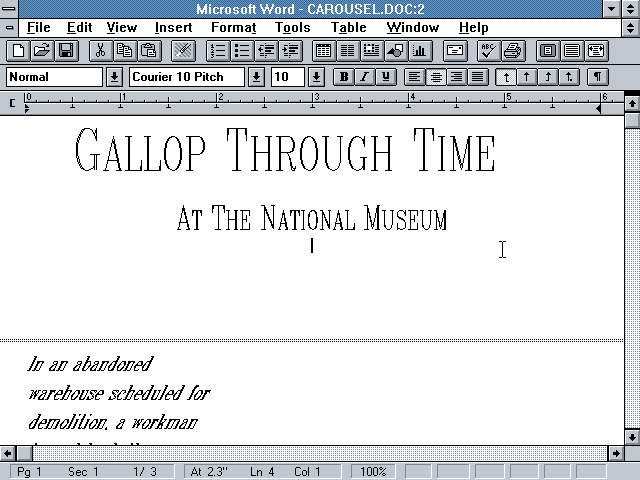
For example, the floppy disk save icon likely appeared in the early 1990s. Pinning down its precise origins proves frustratingly difficult, but we know it was used in Microsoft Word 2, which was released in 1991. At that time, the floppy disk was not purely a skeuomorphic representation of saving—the 3.5” floppy that most commonly appears in save icons was still a primary means of saving files. But in 1991 the floppy was only one storage possibility, as users could also click that icon to save to their hard drive or—more common in businesses—networked storage. In just the next few years, high-capacity zip drives and then consumer-grade writeable CD drives would come into the market. The floppy disk save icon, in other words, emerged precisely at the moment of its transition from direct referent to skeuomorph.
In a culture in the midst of a profound socio-technical shift, the skeuomorph marks an inflection point, a shifting boundary marker along what Alan Liu described as the “thick, unpredictable zone of contact” between new media and old, “more borderland than border line.”3 As N. Katherine Hayles wrote in an article on cybernetics in 1994, “Like a Janus figure, the skeuomorph can look to both past and future, simultaneously reinforcing and undermining both.” Rather than seeing the skeuomorph as merely retrospective, Hayles positions them as “threshold devices, smoothing the transition between one conceptual constellation and another.”4 The skeuomorph is both pedagogical—teaching how to use a new medium by reference to an older, familiar medium—and ideological—suggesting the best use of a new medium.
Book Labs
Discussing skeuomorphs and the floppy disk icon brings us to Skeuomorph Press, which we named after one of my students, Isabella Viega, commented on how often I use skeuomorphs in my classes to discuss historical media shifts. The press’ mark, or logo, was adapted from the floppy disk icon as a way to mark the kinds of cross-historical conversations we hope to foster in our space. At Skeuomorph, we sponsor applied research in book history and creative projects by students and faculty, offer experiential workshops in the history of print technologies, teach modules in classes across departments, and foster a community of makers on campus. Skeuomorph houses an ambitious collection of metal and wood type, as well as printing presses, typewriters, and vintage computers. While we offer instruction in historical media and methods, our ultimate goal in teaching historical technologies is not to cosplay or simulate the past—a frankly impossible goal—but to model particular features of historical media and methods that can help us reflect on the present.
Skeuomorph is one of a growing network of “book labs” and similar humanities maker initiatives around the country. Since 2023, Rare Book School has offered a regular course about establishing book labs, and when we put out a call for a “Building Book Labs” symposium last year, we were forced to expand what we thought would be a small, intimate gathering to accommodate a flood of applicants. That event brought together scholars from longstanding initiatives, newer programs like Skeuomorph, and those exploring founding such initiatives on their campus. This talk kicks off the second book lab symposium, and our colleagues at Yale are well underway planning next summer’s event. As one informal index of this movement’s growth, at the first symposium we started a BookLabs mailing list that now boasts more than 120 members, actively sharing events, resources, and ideas. The scholars running book labs come from traditional humanities disciplines, as well as digital humanities, library and information science, and adjacent fields.
Across those disciplines, scholars are finding new value in analog and craft practices, sharing a sense that they are especially valuable in our current socio-technical moment. Even as we train students in methods such as vector space analysis or large language models, we are increasingly asking students to set type, sew book bindings, pull cotton rag paper, or knit a data physicalization. The materiality of these experiments illuminates in two directions: making the technologies, materials, and laborers of historical information systems more visible, but inevitably pointing—by comparison or contrast—to the complex web of socio-technical systems that underly our own historical moment. In 2024 Isabella Viega and I interviewed scholars working “humanities maker labs” around the country to understand why so many scholars are turning toward material investigation, experimentation, and critical making in their research and teaching. I would be happy to expand on this study in the Q&A, but in extreme brief our interviewees frequently echoed Matthew Kirschenbaum’s ideas in his interview, noting the value of “tangible…work with the hands” for thinking, noting that such tactile experience often translates to better work with programming and digital tools.
When arguing for the value of a space like Skeuomorph for students in information science, who may or may not have an explicit interest in the history of our equipment and materials, I often note that the deliberation required, and even the constraints imposed, by a technology like letterpress translates to design thinking valuable in coding, UI/UX design, and related information science skills. In her interview for our white paper, Kirstyn Leuner, head of Santa Clara University’s Digital Humanities Initiative Letterpress studio, argued that the limitations of material engagement prove valuable for students’ thinking as “they’ll come up with something because they have to, because you’re limited to the typefaces that we have, the sizes that we have, what other people aren’t using.” In the digital age, where excess of choice is the norm, Leuner framed these restrictions as pedagogical affordances, recognizing, “they’re used to not being limited in terms of writing and thinking about composition.” Several participants pointed to these kinds of boundaries as conducive to critical thinking and creativity, as students have to work with not only the materials available, but the constraints of the technologies that use those materials.
We can trace a similar emphasis on the value of the tactile and the material in the constellation of activities collected under the moniker #DHMakes, where digital humanities and adjacent scholars use social media to share their work knitting, zine making, paper piercing, and more. Initially born out of a desire to connect during the most socially-isolated moments of the COVID-19 pandemic, #DHMakes has since grown into an active online community, even sponsoring workshops and panels at DH conferences—including one planned for the upcoming Digital Humanities Conference in Korea thissummer—and supporting an ongoing series of online methods talks. In an article outlining the history and guiding ethos of #DHMakes, Amanda Visconti, Quinn Daedal, and Claudia Berger argue that the movement’s making emphasizes the tactility of digital infrastructure obscured by metaphors such as “the cloud,” while highlighting the history of computing in practices such as textile production, which can be obscured by gendered narratives of the field.
They write, “Representing digital work physically connects us back to the materiality of our digital making and serves as a reminder that the physical is not as distant as we might imagine.” Here again the tactile serves as an alternative means of knowing—thinking through the hands, iterating, tinkering. Visconti, Daedal, and Berger argue “infusing” these craft practices, their values, and the histories they embody will prove essential for “the next generation of digital humanities.”5 I would suggests that the narratives surrounding book labs and #DHmakes alike center on ideas of media and technological transition, of paradigm shift—certainly within fields such as digital humanities, but also across the larger culture, that demand special attention and deliberation.
The Mediation of Books
Book Labs are certainly not first movement that has valued historical practices of textual production. The Private Press Movement of the late nineteenth century and the Bibliographical Press Movement of the twentieth century shaped the foundations of the pedagogical presses that persist in humanities departments and libraries. Although bibliographical presses can still be found at various institutions—including some represented in our audience today—many presses were closed during the ‘digital turn’ of the 1990s and 2000s—not coincidentally, precisely as Gessler and Hayles were beginning to write about skeuomorphs—and indeed many current book labs find themselves working to reconstruct collections sold off twenty or thirty years ago. At Skeuomorph Press, we regularly buy equipment from a private seller only to find a vintage University of Illinois property tag still attached to it.
The private press movement was largely a response to the industrialization and corporatization of book production, as small presses and individual artists sought to revise artisanal practices of fine typography, ornamentation, and binding, creating what William Morris called “the book beautiful.” The aims of this movement were historical but also aesthetic, and largely focused on one end of the spectrum of print culture: the careful production of highest quality books through elite craftspersonship. On the other hand, the emergence of the Bibliographical Press Movement throughout the twentieth century can be traced to the emergence of bibliography as a discipline, as leading scholars in the field established print studios at their respective institutions to conduct research and train aspiring professionals. In 1965, Philip Gaskell defined a Bibliographical Press as “a workshop or laboratory which is carried on chiefly for the purpose of demonstrating and investigating the printing techniques of the past by means of setting type by hand, and of printing from it on a simple press.”6
The twenty-first-century book lab movement reflects some of these impulses, but through a distinct lens that produces distinctly different materials. Whereas the private press movement and the Bibliographical Press movement responded to the industrialization of book production, today’s book labs respond largely to the digitization and algorithmization of culture. As such, they emphasize material engagement and hands-on labor across a wider variety of media and texts—e.g. posters, postcards, bookmarks, broadsides, zines—and focus more on tactile experience than producing flawless prints. In fact, in a media environment where perfectly clean, uniform texts are the expected norm, our whitepaper found that practitioners, students, and the public for twenty-first-century book labs explicitly value markers of materiality that might in previous eras been dismissed as flaws: e.g. uneven inking patterns, chatter, or visible wear and damage to type or cuts. Notably, the media of contemporary book labs perhaps better reflects the material realities of historical print culture, where, as scholars such as Lisa Gitelman have shown, books made up just one part of an industry and profession shaped much more by job printing, and where fine art was often secondary to more practical production.7
Across several influential works in the early 2000s, N. Katherine Hayles argued that the emergence of digital textuality was bringing the mediation of print into sharper focus: making the book apprehensible as a medium, and demanding more sustained attention to the materiality of both print and digital texts. She wrote,
Lulled into somnolence by five hundred years of print, literary studies have been slow to wake up to the importance of media-specific analysis. Literary criticism and theory are shot through with unrecognized assumptions specific to print. Only now, as the new medium of electronic textuality vibrantly asserts its presence, are these assumptions clearly coming into view.8
Just two decades later, the rise of algorithmic systems begins to cast the narratives of the early web and hypertext in a new, comparative light. Alongside their enthusiasm for analog materials such as hand-made paper and print, students wax nostalgic for the old web of hypertext documents and cartoon gifs, seemingly less constrained by capitalism (dot com boom notwithstanding). In another section of this article that I won’t recite today, I ruminate on how emotions such as nostalgia intersect with the work of book labs. In extreme brief, I try to distinguish between misleading and potentially productive sorts of nostalgia: those that summon the past for critical reflection on—versus uncritical comparison to—the present. Here, however, I want to consider how skeuomorphism shapes our encounters with historical and contemporary media, before returning in closing to my opening provocation.
As Patrick Goossens writes, many historical print spaces
mix materials, technologies and techniques from different eras. For instance, when type in a common press is locked up with aluminium furniture and mechanical coins rather than the more historical correct methods of wooden wedges. A careful balance between demonstrating a process and showing historical printing practices should be considered; or at least awareness needs to be cultivated.
Book labs are replete with such anachronisms. We might seek to teach students about early modern book production, but the vast majority of us do so through the tools available to use, acquire, or purchase locally, which for letterpress tend to come largely from the late 19th century—at least for some printing and book presses—up through the mid 20th century, for type, cuts, and similar. Very few of us have the institutional resources to acquire or the expertise or time to recreate artifacts such as historically-accurate wooden hand presses.
Goossens notes that “a certain nervous tension has arisen between traditionally trained compositors and printers and new entrants to the field such as graphic designers, artists or enthusiasts,” as the former worry that “a short course or online learning experience” cannot replace “seven-year apprenticeships” and thus the “reason why things were done the way they were done becomes lost.”9 Goossens is no doubt correct, and as someone in the latter category I feel increasing duty to narrow the gap he identifies. As the book lab movement expands, led largely by scholars without extended practical training in the historical technologies we employ, our community should be working to document, preserve, and pass on the specialized knowledge Goossens rightly worries “will die out,” quite literally. We should also be finding ways to support the spaces and programs that are equipped and able to carry on these traditions.
Keeping these critiques in sight, I also want to carve out intellectual space, and even a distinct mission, for the complex, transhistorical assemblages of equipment and skills one finds in book labs of all shapes and sizes, from media carts wheeled into classrooms to spaces like Skeuomorph press. Book labs are spaces focus on mediation, not simulation. To put it another way, book labs present models of historical book cultures, rather than reenactments. Our work is shot through with skeuomorphism that can catalyze socio-technical and historical critique.
In her short piece, “A Rant About ‘Technology,’” Ursula K. Le Guin—one of the twentieth-century’s great science fiction authors—takes aim at a reviewer who dismissed her work as “soft” science fiction because “technology is carefully avoided” in her work. Le Guin counters by arguing, essentially, that her reviewer has a narrow and uninteresting definition of technology. She defines technology as “The active human interface with the material world,” a definition that includes computers and space ships, but also “flax…paper, ink, wheels, knives, clocks, chairs, aspirin pills,” and “steel saucepans with copper bottoms and fleece vests spun from recycled glass.” Le Guin suggests that, when considering any technology historical or contemporary, one might ask “Do I know how to make one?” Ultimately, Le Guin sees technologies pedagogically:
I don’t know how to build and power a refrigerator, or program a computer, but I don’t know how to make a fishhook or a pair of shoes, either. I could learn. We all can learn. That’s the neat thing about technologies. They’re what we can learn to do.
Refusing a reductive, presentist view of technology, Le Guin instead offers a cross-historical continuum in which technologies from flax to silicon chips converse, and register different facets of humans’ “active interface with the material world.”
This past year, we sought and were granted permission from Ursula K. Le Guin’s estate to produce an edition of “A Rant About ‘Technology.’” The books were illustrated by library science student Delia Kerr-Dennhardt, the type was handset by me, and the book was then printed and bound by Skeuomorph staff and students, including folks like Sophie Weinberg. One goal for this work was certainly to raise money for the press. We we also wanted to honor a text central to our thinking and mission. We are Skeuomorph Press because one of our primary aims is to help students and patrons apprehend the historical contingencies and debts of information technologies, what Alan Liu describes as “the déjá vu haunting of new by old media.”
When we work with historical technologies, our temporal distance from them helps us notice their affordances and limitations more clearly than we can the technologies of our own era. Hayles argued that the particular mediations of print textuality were difficult to perceive without the contrast of digital textuality. Two decades later, as we are fully immersed in digital, computational, and algorithmic cultures, a primary impetus and mission of the book lab must be to provide a vantage from which to perceive and critique the dominant media paradigms of our moment. A skeuomorph embeds a theory about the active interface between humans and the material world: it suggests which aspects of media are vital to retain, and which might be learned from and discarded. It brings the archive into dialogue with the present through a critical-creative practice, what Kadin Henningsen calls “critical fabrication.” The negotiations we make with historical materials engage not only the “gaps, fissures, and erasures of the archive,” but cast the gaps, fissures, and erasures of our own socio-technical moment into sharper relief.
Skeuomorph as Heuristic
Earlier in my talk I discussed the floppy disk save icon as a skeuomorphic design feature from the digital age, but book history is replete with examples. Scholars often write about the conventions of early printed books adopted from manuscript culture, from blackletter fonts that mimic scribal hands, to hand-painting and illumination within printed woodcut illustrations, to the rules drawn between lines of text that had no technical purpose for printed books. Looking at a much more recent period, ]Jamie L. Jones reads](https://www.jstor.org/stable/26556809) the famous Rockwell Kent illustrations for a lush 1930 edition of Moby-Dick, noting that despite Kent’s training in woodblock relief printing, and the fact that “Kent’s illustrations are rendered in thick lines, parallel and horizontal like wood grain itself,” almost none of Kent’s illustrations for Moby-Dick are wood engravings or woodcuts. They are ink drawings that Kent created using a pen, brush, and ink, then sent off to the printer in Chicago, where they were photographed and—depending on the demands of each illustration—hand-engraved, transferred by electrotyping onto a metal plate, or both, by a team of engravers “ Jones reads Kent’s skeuomorphic woodblock illustrations as a kind of “print nostalgia,” signals of his “longing for unalienated preindustrial labor, his political discomfort with his own social and professional privileges, and, at the same time, his complicity with the commercialism of the art world in the early twentieth century.”10
As Jones’ argument demonstrates, skeuomorphs can be subtle clues to historical nuances in media regimes that can be obscured by broad-brush approaches to something like “print culture”—a woodcut-style illustration, executed by pen and then photographed and electrotyped, speaks to a not one unified “print culture,” but instead to a culture that shifted radically between 1830 and 1930. Similarly, William Sherman’s “Toward a History of the Manicule,” he notes that for much of print history, these ornaments “remained very limited in size and surprisingly uniform in appearance and function.” In the nineteenth and twentieth centuries, however, this shifts, as “designs became markedly more elaborate, and more common in a wider range of publications” and contexts, including “a crucial role in the visual vocabulary of advertising.”[^shermanHistoryManicule2008, pg. 39] Originally a skeuomorph drawn from manuscript practice, where these pointing figures served an indexical function, the nineteenth- and twentieth-century manicule becomes a skeuomorph again, this time of earlier print practice, adapting a scholarly reference mark into something simply meant to draw attention in a more crowded print marketplace.
Since at least the 1990s, user interface and user experience professionals have debated whether skeuomorphic design is useful, helping users understand how a new medium works by reference to a familiar medium, or whether skeuomorphism adds unnecessary complexity, or artificially limits the potential of new media by anchoring it to an obsolete past. The notion of a skeuomorph as “nostalgic” or “looking backward” assumes a directionality of media change. If new media is by default better, faster, more efficient, more effective, then remnants of earlier media can hold back its potential—keep it mired in the past rather than pressing toward the future. If instead old media speaks to cultural values, aesthetic preferences, or expressive possibilities, then the skeuomorph is something different: an assertion of history and its complexities in the present. From the perspective of book history, we can refuse this dichotomy, focusing instead on the social, technical, and cultural work they do. From this perspective, skeuomorphs become a heuristic for perceiving the technical, social, and political operations of media technology that can be opaque in any present.
Which leads me back to AI. It seems notable that (at least) two major agentic AI platforms lean heavily into skeuomorphism in their marketing: Meta recently acquired Manus, which brands itself as “hands-on AI” and whose logo resembles nothing so much as a manicule, linking their textual interface to the long tradition I discussed above. OpenAI’s coding platform, Codex, similarly references our bookish past, the bound volumes we might browse in a library. Rather than emphasizing the newness of large language models, these skeuomorphs work to identify these technologies with a longer tradition of information technologies, to suggest familiarity, stability, and reliability.
We should be skeptical of Meta and OpenAI’s invocations of book and media history. What precisely Manus means by “hands-on AI” seems to simply be “agentic AI,” enabling users to automate repetitive tasks, code applications, or visualize data. They lean heavily into media history and metaphors on their “About Us” page, starting with an image that echos Michelangelo’s The Creation of Adam and promising that Manus is “extending human reach,” which to me echos Marshall McLuhan’s definition of media as “extensions” of “our human senses.”11 This rhetoric casts AI not as a replacement for human activity, but a tool that expands the horizon of possibility for the human mind and fingers. The name “Codex” ostensibly originated as as a portmanteau for “code execution,” but the name inevitably summons historical associations of bound tomes, libraries, and formal, structured knowledge. That implication, however, runs precisely counter to how large language models work. While large language models are built on neural networks where the mathematical relationships between tokens are “structured,” the way LLM systems combine those tokens does not lead to structured information or knowledge, but instead to content that is dynamically reconstituted each time a prompt is entered.
A skeuomorph like the floppy disk save icon evokes an earlier medium to represent a media function that, broadly, remains the same: the file is saved, though perhaps to a new substrate like a hard disk. The files and folders on a computer desktop organize information not unlike the paper files in manilla folders stacked on a desktop made of oak, or maple. In the case of Codex, however, I would suggest that the skeuomorphic name fundamentally misrepresents the media actions it purports to signify. In real ways a large language model is the opposite of a bound, structured volume; the name of this tool encourages users to mistake its core operations. A similarly deceitful skeuomorphism is also at play in the core interface of most commercial AI system, the chat.
So now I have finally wound back to my opening provocation: as an interface for interacting with large language models, the chat box relies on a flawed skeuomorphism that misleads users, obscuring rather than revealing the relationship between users’ inputs and the language model systems’ outputs. This fundamental misapprehension shapes every interaction with AI systems and informs the deep and valid discomfort people feel about the rapid and seemingly ubiquitous deployment of AI systems across our professional, civic, and personal lives. When users load ChatGPT, or Claude, or Gemini, they are presented with a text entry bar. While one could type a very long prompt here, the long, thin bar encourages a shorter entry, and recalls two distinct but, I would argue, equally misleading predecessors: the search bar and the text chat.
It feels almost banal to point out that LLMs like ChatGPT are not search engines (though they increasingly are building in search-engine-like capabilities, which we can discuss in the Q&A). There is a growing genre of web pages and library modules devoted to explaining how LLMs’ token prediction assemblage of text operates differently from search, such that their output should not be treated as search results. Less attention has been paid to how the core design of LLM systems’ interfaces encourage such use, exactly mirroring the Google search bar that has become ubiquitous. If you have been using the Google search bar for literal decades—perhaps, as for many of our students, your entire life—you arrive at ChatGPT primed to type in search terms, and to interpret the output as akin to search results.
The other skeuomorphic interface echoed in LLM system interfaces has become a colloquial shorthand for all generative AI: chat. As soon as one enters a prompt, what unfolds is not a list of search results, but instead left- and right-aligned text bubbles that mimic the back-and-forth of a text message thread. As the name “ChatGPT” signals, this skeuomorph is very deliberate, and in fact AI companies tout it as one of the primary innovations of this technology, enabling a powerful computational architecture to interact with uncertain user requests.
Even ChatGPT will report that two motivations for chat interfaces are that chat “hides model limitations” and that such systems are “much cheaper to build,” because such interfaces “let users discover use cases” rather than guiding users toward particular—and, we might argue, better suited—applications. Even here, however, we see that GPT’s training data reflects the idea that chat is an intermediate interface, and that “the likely trajectory is not ‘everything becomes chat.’” Instead, GPT notes that “structured interfaces are making a comeback” as “many AI products are now moving away from pure chat” for the actual execution of ideas. We see this trend in the news everyday, as companies realize that the core function of AI systems, which enable them to work around vague or entirely mistaken user input, also lead to massive and costly problems in their output.
Claude’s response to the same prompt is even more direct, noting that chat:
It conceals the model’s actual operation
This is the less-flattering reason. LLMs don’t actually “converse” in any meaningful sense — there’s no persistent state, no genuine turn-taking, often no memory. But the chat metaphor creates a strong enough illusion of a coherent interlocutor that users engage with it as if it were one. A more honest interface (something like “here is a document, return a transformed document”) would expose that the model is essentially a very sophisticated function, which might actually be more appropriate for many use cases but would feel less magical.
If we credit this reply, the skeuomorph of chat does not signal, but “conceal” the tool’s operation from users. Like GPT, Claude notes that “for many real tasks, chat is genuinely suboptimal” as “Structured output, constrained forms, pipelines with typed inputs and outputs, and direct API integrations are often more reliable and more auditable.” Here LLMs are “essentially a very sophisticated function” which users are deceived by the system’s chat interface into treating as “a coherent interlocutor.” I might be accused of being so duped due to my quoting here, save that I have no illusions that either ChatGPT or Claude understand or are discovering these insights. Instead, these realities are so prevalent across the tokens of their training data that, with the slight nudge provided by the tokens in my prompts, the tools’ output discloses the tools’ own illusionary interfaces. In a separate piece I am writing in parallel to this one, I argue that the text output by an LLM is a bibliographical record of a prompt’s interaction with a specific model through a programmed system. That output is less akin to printed books’ literary or linguistic meanings than to their signatures, chain lines, or fonts. The output testifies to the construction of the textual system.
Ted Underwood has argued that “in historical disciplines, it is far from obvious that all meaning boils down to intentional communication between individuals” as we “rarely have access to minds, or even living subjects,” but instead “texts and other traces.” For Underwood, “The immediate value of these models is often not to mimic individual language understanding, but to represent specific cultural practices.”12 If we consider the LLM output I share here not as understanding—or even as information, frankly—but as models of culture, we can ask what cultural ideas they reflect back to us.
To that end, it seems notable that both GPT and Claude’s responses also highlight the historical circumstances that set chat as the dominant interface for interacting with LLMs. GPT writes:
There’s also a historical coincidence: the breakthrough models happened to be language models.
If the first highly capable AI systems had emerged from a different paradigm—say visual reasoning systems or planning systems—the dominant interface might not have been chat at all.
Claude too notes that after “Early public demos…established chat as the legible format for ‘what this thing does’…the industry largely converged on it.” For book and media historians, these small details should be salient. I have been arguing throughout this talk for a skeuomorphic perspective, and here the tools themselves expose cracks in the technological determinist narrative through which these tools are sold to us, or to our university administrators. This is not a narrative of inevitability, but of historical contingency.
While these details of skeuomorphic interface might seem like a small details, they reveal key truths about the gap between the rhetoric about these technologies and their actual function. And this, to my mind, should be the core work of book labs. They can be spaces that inculcate critical attention, that place history and the present in active dialog through both theory and hands-on praxis. Skeuomorphs mitigate against technological determinism, showing the choices made in the design and operation of a new medium or technology, and suggesting alternative futures we might pursue.
-
Colley March, H. “The Meaning of Ornament.” In Transactions of the Lancashire and Cheshire Antiquarian Society. Lancashire and Cheshire Antiquarian Society, 1890. https://archive.org/details/transactionslan06socigoog/page/n180/mode/2up. ↩
-
Gessler, Nicholas. “Skeuomorphs and Cultural Algorithms.” In Evolutionary Programming VII, edited by G. Goos, J. Hartmanis, and J. Van Leeuwen, vol. 1447, edited by V. W. Porto, N. Saravanan, D. Waagen, and A. E. Eiben. Lecture Notes in Computer Science. Springer Berlin Heidelberg, 1998. https://doi.org/10.1007/BFb0040776. ↩
-
Liu, Alan. “Imagining the New Media Encounter.” In Companion to Digital Literary Studies. Blackwell Companions to Literature and Culture. Blackwell, 2008. http://www.digitalhumanities.org/companion/view?docId=blackwell/9781405148641/9781405148641.xml&doc.view=print&chunk.id=ss1-3-1&toc.depth=1&toc.id=0. ↩
-
Hayles, N. Katherine. “Boundary Disputes: Homeostasis, Reflexivity, and the Foundations of Cybernetics.” Configurations 2, no. 3 (1994): 441–67. ↩
-
Visconti, Amanda, Quinn Dombrowski, and Claudia Berger. “#DHmakes: Baking Craft into DH Discourse.” Korean Journal of Digital Humanities 1, no. 1 (2024): 73–108. https://doi.org/10.23287/KJDH.2024.1.1.5. ↩
-
Philip Gaskell, “The Bibliographical Press Movement,” Journal of the Printing Historical Society 1 (1965). ↩
-
Gitelman, Lisa. “Print Culture (Other Than Codex): Job Printing and Its Importance.” In Comparative Textual Media: Transforming the Humanities in the Postprint Era, edited by N. Katherine Hayles and Jessica Pressman. University of Minnesota Press, 2013. https://doi.org/10.5749/minnesota/9780816680030.003.0008. ↩
-
Hayles, N. Katherine. Writing Machines. MIT Press, 2002, pg. 68. ↩
-
Goossens, Patrick. “Preserving Historically Correct Letterpress Printing in Theory and Practice.” In Letterpress Printing : Past, Present, Future. Peter Lang Ltd. International Academic Publishers, 2023, pg. 117-118 ↩
-
Jones, Jamie L. “Print Nostalgia: Skeuomorphism and Rockwell Kent’s Woodblock Style.” American Art 31, no. 3 (2017), pg. 4. ↩
-
McLuhan, M. “The Medium Is the Message.” Media and Cultural Studies: Keyworks, 1964, pg. 21. ↩
-
Underwood, Ted. Mapping the Latent Spaces of Culture. October 20, 2021. https://hcommons.org/deposits/item/hc:41973/. ↩